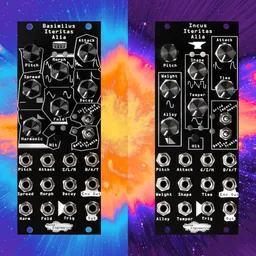
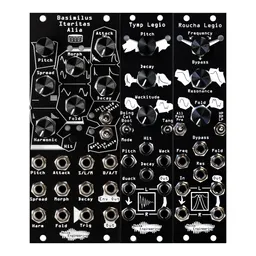
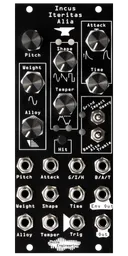
We recently chatted with a few Alia users on our Discord, and the discussion of Incus and its differences (and similarities) to the BIA arose. We realized that we wanted to go more in depth on the topic, so today, we’ll chat a bit about the history of the BIA, the development of Incus, where they shine the most, and which might be right for you.
BIA backstory

The BIA’s story starts in 2014, with the release of the original Basimilus Iteritas. Only a few hundred of the original Basimilus Iteritas were built, but it was the start of something much greater. When it was released, the Eurorack percussion scene was much smaller. In the time since, a slew of fantastic percussion-oriented synth voices from a wide variety of manufacturers have surfaced, but at the time it was relatively unique. While it took inspiration from analog drum sounds, it wasn’t a direct clone of any particular drum voice, and it featured unique synthesis techniques with CV control over every parameter, unlocking the ability to sound like multiple different sounds in a single patch. Basimilus Iteritas was one of the first to do this, and we like to think it was a pioneer in the realm of flexible percussion synths.
Pretty soon after release, Stephen took a look at a module made by our pal Chris at Audio Damage, and realized that he had erred in not including a pitch envelope. That regret led to the
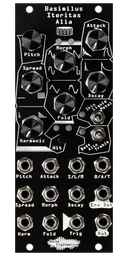
Basimilus Iteritas Alter, which was introduced in 2016. It was smaller, featured even more CV inputs (with improved functionality), and had new modes and refined synthesis algorithms that unlocked even more hard-hitting sounds (including that pitch envelope, and a redesigned daughterboard with no jumpers and other improvements). Now most commonly referred to as the BIA, this was the voice that in many ways defined who Noise Engineering was for the better part of a decade.
In 2023, the CPU that the BIA (and original BI) ran on was end-of-lifed, and we were forced to discontinue the BIA (and our other oscillators). Having seen the love that our community had for the Versio effects platform, we decided to bring the same concept to our oscillators: allow users to freely swap their oscillators to different firmwares, changing their sound entirely with a simple USB connection. The new generation of CPUs made this far easier than the weird chip we used on the original modules. Enter Alia: we spent a lot of time making sure that all of our oscillators sounded nearly identical on the new Alia hardware as they did in their original iterations, and the BIA was no exception. If you want the classic BIA sound, you get it on the Alia platform, now with an envelope output and on a flexible hardware platform.
That got us thinking, though, what if we rethought the BIA concept from the ground up?
Enter Incus

The idea behind Incus was simple: take the things that make the BIA awesome, but redevelop it from the ground up using modern Noise Engineering technology.
The core of Incus was developed in an afternoon. Well, sort of: over the years, Stephen has developed a huge library of code that allows him to quickly get ideas into hardware using building blocks of different synthesis concepts. Additionally, we have an extra ten years of development experience and customer feedback to build off of since the BIA was originally developed. This meant that Incus came together very quickly, but was also more refined in both playing experience and sound.
As we worked on Incus, we had two main priorities. Make a drum synth in the BIA package that felt like the original but had even more range, and make the parameters even more fun to use.
The first goal was pretty straightforward: Stephen has developed a lot of synth voices by now, so we spent some time tweaking envelopes and extending parameter ranges (the pitch envelope underwent a lot of back and forth), but we were pretty happy with the synthesis engine that came from the core design.
Refining the interface took a bit more doing. The envelope section of the original BIA is unusual, so we wanted to standardize the envelope behavior across modes, and separate the two envelope controls in a way that was more similar to our big synths like Loquelic Iteritas Percido. Attack is always bipolar, introducing a timbral change below noon and increasing attack time above noon in all three modes. We also refined Weight and Alloy (Harm and Spread on the BIA) so that no matter their relative positions, they would work individually or together to change the sound of the synth.
At the end, we had a new synth voice that played like the original, but was even deeper and, dare we say it, we preferred in some regards to the original BIA.
Preference
In a lot of our patches, we’ve come to prefer the Incus. We’ve spent a lot of time playing the original BIA over the years, so having a new take on the traditional algorithms has brought new life to our patches. With its refined algorithms and extensive range, it’s an excellent synth voice that covers almost any percussive (or melodic, or bass…) sound you can think of.
That said, sometimes there’s no replacement for the original. The BIA is a classic for a reason, and sometimes you just need that thwanging (it’s a word, I swear) wavefolder over a big additive kick, and there’s no alternative.
Try ‘em out
If you have an Alia, the great thing is that you can compare the BIA to Incus (and all the other synths and oscillators on the Alia platform) by swapping the firmware. You can swap whenever you want, however many times you want, completely free, so it’s easy to experiment and see which one suits your patches best!