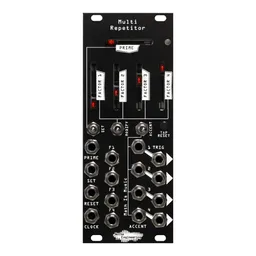
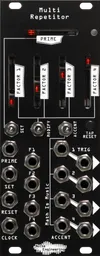
Last week, we introduced Multi Repetitor, our new rhythm generator and spiritual successor to Numeric and Zularic Repetitor. If you haven’t dug into all of the fun and interesting ways it can generate rhythms, check out last week’s blog to get an idea of what it can do.
If you’re itching for more, though, this week we’re exploring some fun patches using Multi Repetitor and some other Noise Engineering utilities. The video below shows off some of the techniques described, with chapter markers for each if you’d like to hear some examples.
Patching accents
One of the easiest ways to bring a Multi Repetitor patch to life is with the accent outputs. Many dedicated drum modules have dedicated accent inputs, which makes patching them pretty self explanatory.
However, some voices, like our Alia drums, have more versatile CV inputs. If you have some attenuators in your system, you can route the accent gates through them, then to a CV destination like decay time, wavefold amount, or any other parameter that sounds good with some accented punch.
You can get even more creative by patching the accent out to a mult and then into multiple attenuators to create a mini modulation bus. If you have one of our Sinc Defero attenuating mults, you can do this automatically. On my Incus Iteritas Alia, I like to route an accent to Time for extra decay, Temper for some timbral shift, and also a VCA patched from the output to increase the output level on accented notes.
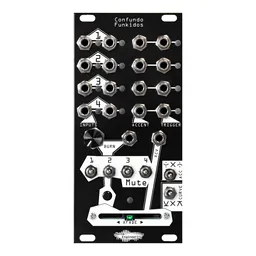
Confundo Funkidos+Multi(ple) Repetitors
If you’ve been in the Noise Engineering community for a while, you may have seen us patch Numeric Repetitor, Zularic Repetitor, and Confundo Funkitus together in demos and performances. Trigger sequencing was a bit more simplistic then (we don’t like to think about the fact that the original Repetitors are twelve years old) but we still find it to be a fun patch a decade later.
If you want to try out an even more jammable setup with the next generation of modules, patch up your Confundo Funkidos, a Multi Repetitor on the left inputs, and another trigger source – perhaps you still have a Numeric or Zularic Repetitor in your system – on the right inputs. Clock everything together, then play all of the faders and mutes like there’s no tomorrow!
Multi Repetitor+Mimetic Digitwolis=Besties
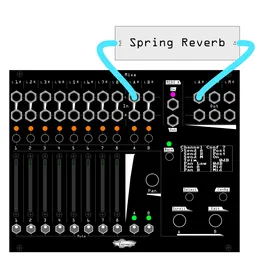
Our recently released Mimetic Digitwolis was designed for versatility, and there are a number of fun ways that Multi Repetitor can be patched with it.
Starting simple, load up the Pitch x 4 preset on Mimetic Digitwolis. Mult the trigger outs from Multi Repetitor to four voices in your system, and to the Trig Ins 1-4 on Mimetic Digitwolis. Tap in a tempo on Multi Repetitor, program (or Shred!) a sequence on Mimetic Digitwolis, and you’ve got a complete melodic sequencing solution!
You can also go the opposite direction. Try configuring Mimetic Digitwolis with an internal clock, use one lane as a trigger output to clock Multi Repetitor, then use three CV lanes to modulate Prime and/or some Factors. Try advancing CV lanes at different periods – each measure, or half measure, perhaps – for slowly changing trigger sequences that loop around.
And more…
This post just scratches the surface of the creative ways you can use Multi Repetitor. We always want to hear what you’re doing with our gear: if you create something particularly groovy, tag us on social media, drop into our Discord, or send us an email!