Who are you and what do you do?
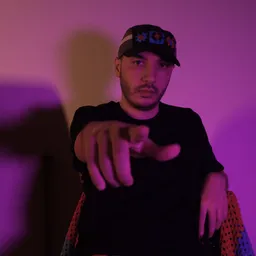
I am Molotof, an artist from Egypt. I graduated from the Academy of Arts, the High Cinema Institute in Cairo, as a film editor. However, during that time, I discovered my true journey lay in music. Today, I am a composer, rapper, filmmaker, and visual artist. I am also the pioneer of the Molowave movement.

How did you get started in electronic music?
I started as a rapper, and then a friend showed me Ableton Live so I could make my own beats. At the same time, I discovered techno. When I listened to it, I felt the same intense, internal energy I experienced during the Egyptian Revolution in 2011. That period had a massive impact on me. I began experimenting in Ableton, making techno and blending it with Egyptian street music, like Mahraganat. That is how I discovered my own signature sound.
You're known for Molowave—a blend of Egyptian music, electronic music, and hip-hop. Molowave isn't really a genre, but more a movement. Tell us about it and what inspired this sound.
What inspired this sound is my love for all these genres and the freedom of modern DAWs to blend any style I want. I asked myself: “Why make music that is purely Western or purely Egyptian? Why not bring all the sounds I love into one place?” That is how Molowave was born.
Beyond the music, Molowave became a movement to rediscover the "Roots" of the human spirit. I realized we are often trapped in a "Matrix" of social constraints. To break out, you need extreme energy and a touch of madness. Molowave uses the raw energy of Egyptian street music mixed with aggressive electronic synthesis to push the listener toward their true, free self.
What can you tell us about your workflow? How do you make the music you make?
My workflow is split into two parts. The first is building and refining my setup. My rig is almost entirely software-based, with the exception of my Novation Bass Station 2. I love the freedom of making music on a laptop anywhere—in nature or even in bed.
I use Ableton Live and have built a custom system of "Molowave" racks and templates. I design my own drums by blending electronic hits with traditional Egyptian samples. For example, I might process a tabla or dof with distortion and phasers, layer it with an electronic snare, and export it. That is how I create my new "Alien Cairo" drum sounds, which I then save into loops and Ableton Drum Racks.
On the synth side, I look for sounds that are organic, industrial, and unique to support my "Alien Cairo" aesthetic. I want to hear Egyptian Maqamat (scales) played through synths rather than just traditional instruments. When that happens, I feel like I’m accessing another dimension—it’s as if the sound is originally from another world and I am simply bringing it here. This is why I love Noise Engineering plugins; they support custom tunings and scales via files or MPE, which works perfectly with the Ableton 12 tuning system.
The second part of my workflow is about the spirit—entering the "Flow State." In this phase, I don't focus on sound design; I use my prepared tools and presets to capture the sound in my head as fast as possible. Everything becomes rapid; I am creating and dancing at the same time. This is another reason I love Noise Engineering—the modulation system is the fastest and most interesting I’ve used. I can modulate multiple parameters quickly to create a "living" sound even while in the heat of a flow state.

Most of our readers won't know much if anything about the Egyptian music scene. What can you tell us about it?
The Egyptian scene is incredibly diverse. Egypt has always been a cultural center; any Arab musician wanting a big career usually comes to Cairo. Since the 2011 Revolution, the art has become even more experimental.
We have Mahraganat, a raw, authentic genre born in the streets. You hear it everywhere, from "Tuk-Tuks" to high-end clubs. It’s a blend of Hip-Hop and traditional folk music with hard-hitting, industrial bass and kicks that sound exactly like the energy of Cairo. Then there is Egyptian Rap, which moved from the underground to the commercial mainstream around 2018.
Nowadays, all these genres are merging. Producers like myself are bringing pure electronic elements into this space. You might hear a Mahraganat track with a 303 acid line in the background and someone rapping over it. That is the heart of the Molowave sound: showing the scene that we can take the Western sounds we love, blend them with our own culture, and create something with total freedom.
How do you bring that modular mentality into a DAW like Ableton?
I spent months exploring the world of modular synthesis through VCV Rack. That was a huge turning point for me; it taught me how to think about sound as a series of interconnected voltages and modulations. However, I eventually realized that my "flow state" is fastest inside Ableton Live.
My mission became: How do I bring that wild, modular unpredictability into the speed of my DAW workflow? I started building my own "Molowave Racks" in Ableton and using Max for Live modulators to mimic modular systems. This led me straight to Noise Engineering and Madrona Labs (Aalto), and I am also experimenting with HY-MBMFX3, a modular multi-effect plugin. These plugins give me that raw, "West Coast" synthesis feel—where the sound feels "alive" and on the edge of chaos—while allowing me to work with the precision and speed I need, because for me, the Arrangement View in Ableton is how I finish my tracks.

Where can people find your work?
-
Website: www.molotofmusic.com
-
YouTube: youtube.com/molotofmusic
-
Instagram: @molotofmusic
You can jump into a trip with Molotof through his Boiler Room Set which has been on rotation here at NEHQ!