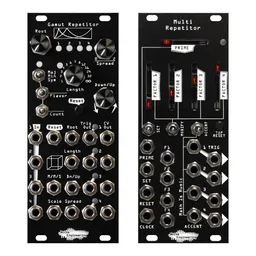
Over the holiday break, Stephen put together a shockingly versatile generative-sequencing setup for a melodic skiff using some of the newer modules in our lineup. Today, we’ll explore a simple generative patch that has been scientifically proven (read: Stephen played on it for a long time) to generate evolving melodic patterns for as long as you want to jam.
The rhythms: Multi Repetitor
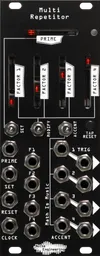
Multi Repetitor, our newly-released trigger generator, is a fabulous choice for any generative patch. The four trigger outs can create patterns for up to four individual voices, and the accent outs add variety, dynamics, or timbral changes, depending on how they’re patched. It’s easy to start a patch with Multi Repetitor, too: just tap in a tempo and it starts generating triggers.
The melodies: Gamut Repetitor
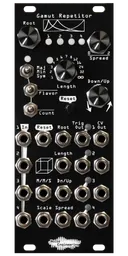
Gamut Repetitor is the other part of the sequencing equation. With four CV outputs and four individual advance inputs, it’s the perfect add-on for Multi Repetitor… almost like we designed it that way. Plus, in gate passthrough mode, you don’t even need mults to trigger your voices from the Multi Repetitor patterns!
The voices: [redacted]
In the video, Stephen is using a super-duper top secret alternate Legio firmware (did we mention it’s a secret?) as the melodic voices in his skiff. The (as mentioned before, incredibly secret) firmware is a simple two-operator FM voice that isn’t quite ready for prime time, so if you want to try something similar, voices like Debel Iteritas Alia or complex waveforms through lowpass gates will do the trick.
Processing
For a classic ambient patch, reverb is a welcome addition. A small mixer like Xer Dualis will bring all your voices together, and our classic Desmodus Versio can bring the atmosphere like no other. Try a relatively gentle setting on your reverb – four voices is already a lot of sonic power.
Putting it all together
Multi Repetitor advances the four lanes of Gamut Repetitor, which in turn sequences the pitch and gate of four melodic voices. If you want to get more complex, patch the Multi Repetitor accent outs through an attenuator and into a suitable destination (like decay time, or a timbral CV input) and add another layer to your patch. Tap a tempo in on the Multi Repetitor and you’re off!
Simple tweaks to the Prime rhythm in Multi Repetitor will create new rhythm sets, and adjusting the Factor faders will add variation to the individual outs. Dial in the Gamut to taste, and start with an infinite Length: this will generate new patterns forever, and once you hear something you like, turn Length down to repeat the previous steps. Since the number of triggers in the Multi Repetitor output patterns can differ from the Gamut Repetitor sequence length, even a simple sequence will have a lot of variation before looping to the start again.
Keep it simple
The beauty of a patch like this is that all of the sequencing is done by just two modules: one trigger generator, and one CV generator. This makes it easy to play, since there aren’t a ton of controls – but with four voices, the results are melodically complex. If you want to get fancy, patch a slow LFO through a mult and some attenuators and into the timbral parameters of your voices so they change over time, too.
If you have your own generative tips and techniques, we’d love to hear about them! Tag us on Instagram or join the chat on Discord to share your favorite patches.